
You see it in a TikTok comment, a Snapchat reply, or a casual text from a friend “ion know” or just plain “ion.” Your first instinct might be to think of chemistry class, but that is definitely not what they mean. ION meaning in text is one of the most searched slang questions right now, and for good reason. It looks scientific, sounds unusual, and its meaning shifts depending on who is saying it and where.
This guide covers everything the primary meaning, alternate meanings, how it differs by platform, tone breakdowns, real examples, and the one quick trick to always know which meaning applies.
What Is ION Meaning in Text? What It Really Stands for in Chat (Primary Meaning)
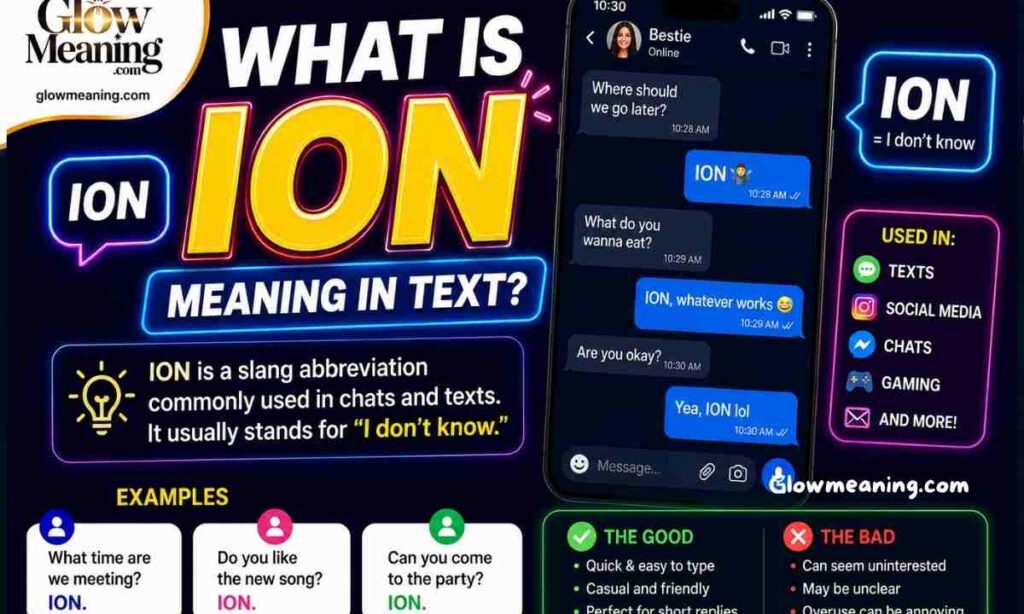
ION in text primarily means “I don’t.” It is a phonetic spelling meaning people started writing the word exactly the way it sounds when spoken quickly in casual conversation. Say “I don’t” fast and casually, and it naturally compresses into something that sounds like “eye-on.” That sound became the spelling, and the spelling became internet slang.
This usage originated from African American Vernacular English (AAVE), where natural speech patterns shaped how the phrase was pronounced. Over time it moved from spoken language into text messages, then into social media captions, comments, and DMs across every major platform.
The secondary meaning of ION used in a different context entirely is “In Other News.” This version functions as a topic-transition phrase, similar to “anyway” or “on another note.” The two meanings look identical but behave completely differently in a sentence, which is what makes ION worth understanding properly.
What ion mean
At its simplest: ion = I don’t. That is the version you will encounter 95% of the time in casual texting, Gen Z communication, and social media platforms like TikTok and Snapchat.
When someone texts “ion like that” they are saying “I don’t like that.” When someone replies “ion know” they mean “I don’t know.” The letters do not stand for separate words the way traditional acronyms do — they represent a sound. That is what makes ion unique compared to most text abbreviations.
The word is almost always written in lowercase. Seeing “ion” with a small “i” is the casual, everyday version. Seeing “ION” in all caps at the start of a sentence usually signals the “In Other News” meaning instead.
Quick Summary
| Form | Meaning | Common Context |
| ion (lowercase) | I don’t | Gen Z texting, TikTok, Snapchat, casual DMs |
| ION (at start of sentence) | In Other News | Topic transitions, older internet users |
| ION (in science) | Electrically charged atom/molecule | Chemistry, physics, medical documents |
| ION (branding) | Company/product name | Business, marketing |
ION = “I don’t”
This is the meaning that dominates in 2026. “Ion” replaces the contraction “I don’t” in casual spoken-style writing. It is not an acronym — it is a phonetic shortcut that reflects how fast, natural speech actually sounds.
The reason it spread so quickly is that it fits perfectly with how Gen Z prefers to communicate: fast, low-effort, and conversational in tone. Typing “ion” instead of “I don’t” saves only a few keystrokes, but it also signals a cultural fluency — a way of showing you are part of the same online space as the person you are talking to.
Understanding this helps decode messages instantly. “Ion even care” = “I don’t even care.” “Ion think so” = “I don’t think so.” “Ion wanna go” = “I don’t want to go.” The pattern is consistent once you see it.
Chat-Style Examples
Here are natural conversation examples showing how “ion” works in real use:
Friend asking about plans: Tyler: “You coming to the thing tonight?” Jamie: “Ion feel like it tbh, I’m tired.”
Sharing an opinion: Alex: “You think she meant it seriously?” Sam: “Ion know, could’ve been a joke.”
Casual pushback: “Ion even wanna talk about it right now.”
Expressing surprise: “Ion believe he actually did that 💀”
Declining something: “Ion eat spicy food so I’ll pass on that.”
Each example shows ion sitting naturally in the place where “I don’t” would normally go — no punctuation drama, no capital letters, just clean casual flow.
Why This Meaning? Tone & Emotion
ION is tonally neutral on its own. The emotion behind it comes entirely from what surrounds it. That is what makes it so flexible — and occasionally confusing.
| How “ion” Is Used | Emotional Tone |
| “Ion know lol” | Lighthearted, casual, friendly |
| “Ion even care anymore.” | Tired, frustrated, done with something |
| “Ion think that’s a good idea” | Gentle disagreement, thoughtful |
| “Ion wanna talk about it” | Deflecting, closed off |
| “Ion like him ngl” | Direct, honest, slightly bold |
| “Ion believe this just happened 😭” | Shocked, dramatic, often funny |
The word itself does not carry a mood. Context, emojis, punctuation, and the conversation before it supply all the emotional information. A period after “ion” makes it feel flat or final. An emoji makes it warm or playful. No punctuation at all reads as completely casual.
Other Meanings of ION (Context Matters)
ION = “In Other News”
This is the secondary meaning of ION and it functions very differently. When someone writes “ION, something interesting happened today,” they are not saying “I don’t, something interesting happened today.” They are using ION the way you would use “anyway” or “changing the subject” — to shift a conversation from one topic to another.
This usage is more common among older millennials and internet users who became familiar with it through forums, blogs, and early social media. On platforms like Reddit and Twitter, you may still see it used this way, especially in longer threaded conversations.
The easiest way to tell which meaning applies: if ION appears at the start of a sentence and what follows is a completely new topic, it almost certainly means “In Other News.” If ION appears mid-sentence replacing a verb phrase, it means “I don’t.”
ION = Ion (Science Term)
In chemistry and physics, an ion is an atom or molecule that carries an electrical charge because it has gained or lost one or more electrons. This is completely unrelated to slang. If you see “ion” in a science class, a research paper, a medical chart, or any technical document, it refers to this scientific definition — not the texting abbreviation.
Confusing the two in the wrong context would be genuinely awkward in either direction. Your chemistry teacher does not want to hear about Gen Z slang. Your group chat does not want a chemistry lecture.
ION = Internet of Things (Old Variant: IoN)
In older tech and networking discussions, IoN sometimes appeared as a variant abbreviation for “Internet of Nodes” or related networking concepts. This usage is niche, outdated, and almost never seen in everyday conversation. If you encounter it, it will be in a technical or academic context.
ION = “I’m On Now”
A less common but real usage — some people write ION to mean “I’m on now” in gaming or chat contexts, signaling that they are online and available. This is contextual and not widely adopted enough to be the default assumption.
ION = Name / Branding
ION is also used as a brand name or company identifier across various industries — from streaming networks to technology firms. Several companies use ION as part of their official name or product branding. In these cases it is simply a proper noun with no slang implication.
Which Meaning Is Correct?
There is no single “correct” meaning — there is only the most accurate meaning for the specific context you are reading. Here is the logic that makes it simple:
If the word is lowercase and sits where “I don’t” would fit grammatically, it means “I don’t.” If the word is capitalized and introduces a new topic, it means “In Other News.” If it is in a scientific or technical document, it is the chemistry term. Everything else is context-specific and usually becomes clear within one or two surrounding words.
According to Merriam-Webster’s discussion of evolving slang, slang terms regularly develop multiple meanings over time as different communities adopt and adapt them — and ION is a textbook example of exactly that process.
When to Use It & When to Avoid It
Use ION When:
You are texting a close friend who is familiar with internet slang, commenting on TikTok or Instagram in a casual way, replying in a Snapchat streak where speed and brevity matter, or participating in any informal online conversation where the other person will recognize the shorthand immediately.
Avoid ION When:
You are writing to someone older or less familiar with Gen Z slang, communicating professionally via email or Slack, submitting any academic assignment, or having a serious conversation where being misunderstood would matter. In those cases, spelling out “I don’t” takes two extra seconds and removes all ambiguity.
Usage Table
| Situation | Use ION? | Reason |
| Text with a close friend | Yes | Fits casual, fast-paced tone |
| TikTok comment | Yes | Standard for the platform |
| Snapchat reply | Yes | Speed and brevity are the norm |
| Instagram DM | Yes | Casual context, widely understood |
| Work email or Slack | No | Reads as unprofessional or unclear |
| Text to a parent or teacher | No | Likely to cause confusion |
| Academic writing | Never | Completely inappropriate |
| Discord gaming chat | Yes | Casual platform, slang is common |
Top Usage Tips
Match your audience first. ION only lands well when the other person already understands it. If there is any doubt, spell it out. Using slang with someone who doesn’t recognize it creates more confusion than it saves time.
Watch your capitalization. Lowercase “ion” reads as “I don’t.” Uppercase “ION” at the start of a sentence may read as a topic transition. The same three letters carry different signals depending on how you format them.
Add an emoji when tone is unclear. “Ion know” alone can sound deflective or dismissive. “Ion know 😅” reads as genuinely uncertain and lighthearted. The emoji does the emotional work that punctuation often cannot.
Never use it in writing that gets evaluated. Not emails, not school submissions, not professional documents. The clarity cost is too high for the character savings.
What Does “ION” Mean on Snapchat
On Snapchat, ION means “I don’t” — almost without exception. The platform is built around fast, casual exchanges, disappearing messages, and informal communication. In that context, “ion” fits naturally as a quick, expressive reply that keeps the conversation moving.
You will see it in streak replies, chat bubbles, and Story responses. “Ion feel like going out” or “Ion even know lol” are both completely standard Snapchat communication. Nobody on Snapchat is using ION to mean “In Other News” — the speed of the platform makes that version feel out of place.
What Does “ION” Mean in Text From a Girl
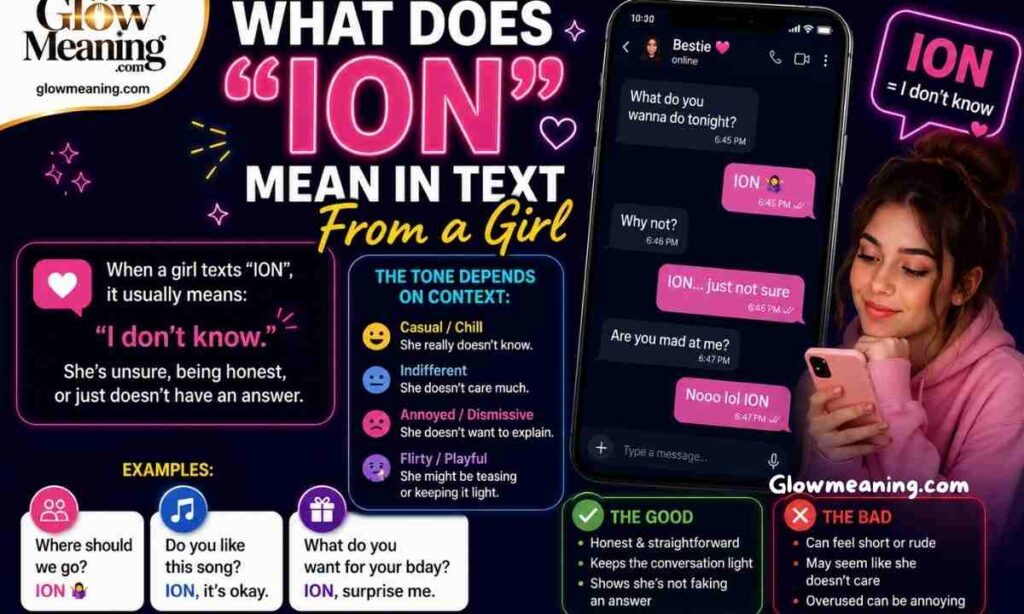
When a girl texts “ion,” she is almost always saying “I don’t” — same meaning, same tone, same context as anyone else using the slang. The word does not carry a gender-specific meaning.
That said, tone matters. “Ion wanna talk about it rn” from a girl in the middle of a conversation suggests she is deflecting or needs space. “Ion even know what to do 😭” is more vulnerable and open. “Ion care what they think” is confident and direct. The word is neutral — what comes after it tells the real story. For a deeper look at WTV and other related slang, check out this guide to WTV slang meaning for full context on similar expressions.
What Does “ION” Mean on Instagram
On Instagram, ION appears in DMs, comment sections, and occasionally in captions. The meaning is consistently “I don’t” in this context. Instagram’s culture of quick, expressive communication makes ION feel natural, especially in comment threads where brevity matters.
In captions, people use it to sound casual and unfiltered — “ion care what anyone thinks, I’m posting it” communicates confidence and an unbothered attitude. In DMs, it functions exactly like it would in any other private text conversation.
Ion in text meaning reddit
On Reddit, you will encounter both meanings of ION depending on the subreddit and the age of the users. In Gen Z-heavy communities, subreddits focused on memes, gaming, pop culture, and social media — “ion” almost always means “I don’t.” In older, more text-heavy communities where internet forum culture is dominant, ION may still appear as “In Other News” especially when someone is shifting topics in a long comment.
Reddit’s text-first format means capitalization and sentence position are the fastest way to identify which meaning someone intends.
ION Meaning in TikTok Slang
TikTok is arguably where “ion” as “I don’t” became a mainstream term for the broadest possible audience. Video captions, comment sections, duets, and stitch responses all feature “ion” regularly — and on this platform it is almost always the “I don’t” meaning.
TikTok’s algorithm surfaces content to people outside a creator’s immediate circle, which helped “ion” spread far beyond the communities where it originated. By 2025 and into 2026, it has reached a point where anyone who spends regular time on TikTok recognizes it immediately, regardless of age or background.
ION Meaning in Text (Urban Slang Explanation)
In urban slang communities, “ion” carries the same core meaning — “I don’t” — but often with more attitude packed into it. It signals casual confidence, a certain effortlessness in communication, and cultural fluency with AAVE-influenced internet language.
Using “ion” correctly in these spaces signals that you are comfortable with the community’s communication style. Using it incorrectly or in the wrong tone can stand out as performative or forced. Authenticity matters in slang communities more than in any other context.
ION Meaning in WhatsApp
WhatsApp sits somewhere between personal and semi-formal depending on the group. In friend groups and casual chats, “ion” works perfectly — it is widely understood and fits the informal tone. In family groups, work groups, or chats with older relatives, it can create confusion and is better avoided.
The private, one-on-one nature of WhatsApp DMs means that tone carries more personal weight than it does in public comment sections. A blunt “ion wanna talk about it” in a WhatsApp chat with a close friend lands differently than the same message in a TikTok comment. Relationship context shapes how every message lands.
ION Slang Pronunciation
ION is pronounced “eye-on” — that is exactly why it became the written form of “I don’t.” When someone says “I don’t” quickly in natural, casual conversation, the “d” softens and disappears and what remains sounds like “eye-on.” Texting captured that sound and turned it into a fixed spelling.
This is called phonetic spelling — writing words the way they sound rather than the way they are formally spelled. It is a common feature of AAVE-influenced internet slang and helps explain why so many people encountering “ion” for the first time feel like it should sound more complicated than it is.
What Does “I O” Mean in Text
“I O” is not the same as “ion” — it is usually a typo or autocorrect error rather than an intentional slang term. If someone sends “i o” in isolation it is almost certainly an accidental send or an incomplete message. It does not carry a recognized slang meaning the way “ion” does. If you receive it, asking for clarification is completely reasonable.
Real Conversation Examples
1. Casual Rejection Friend: “You wanna grab food?” You: “Ion feel like going out today, can we just order in?”
2. Sharing Feelings “Ion even know how to explain what I’m feeling rn.”
3. Topic Change — “In Other News” “So that situation was stressful. ION, did you see what happened on the show last night?”
4. Scientific Use Lab report: “The sodium ion carries a positive charge in aqueous solution.” (This has nothing to do with slang.)
5. Gaming Chat Player: “You want to run another match?” Response: “Ion have time, I gotta log off soon.”
Related Slang
Several slang terms live in the same conversational space as ION and are worth knowing alongside it.
NGL means “Not Gonna Lie” — often used before honest opinions, similar to how “ion think” introduces a candid take.
IDK means “I Don’t Know” — the more standard abbreviation for the same idea as “ion know,” but less culturally specific.
TBH means “To Be Honest” — signals that something direct or truthful is coming, often paired with “ion” in the same sentence.
IDC means “I Don’t Care” — more blunt and final than “ion care,” which carries a slightly softer edge.
NVM means “Never Mind” — used to retract or redirect, often appears alongside “ion” in conversations where someone decides to drop a topic.
Platform Differences
On Instagram, ION = “I don’t” in both DMs and comment sections. Captions use it to project a confident, unbothered personality. The platform’s culture of personal expression makes it feel natural there.
TikTok
TikTok normalized “ion” for the widest audience. Comments, captions, and creator responses all use it freely. It is so common here that most users recognize it instantly regardless of age.
Snapchat
Snapchat’s fast, disappearing format makes “ion” a perfect fit. Almost always means “I don’t.” The “In Other News” meaning virtually never appears here.
Twitter/X
Both meanings can appear on Twitter/X depending on community and thread length. Gen Z accounts use it as “I don’t.” Older forum-style discussion threads may use ION as a topic transition. Capitalization and sentence position help distinguish which is which.
WhatsApp / iMessage
Works well in close friend chats. Carries more personal emotional weight than in public comment sections. Avoid in family or professional group chats where not everyone will recognize the slang.
Discord / Gaming Platforms
Casual and practical. ION = “I don’t” in almost every case. Gaming communities use slang freely and nobody reads into it. It is a low-stakes environment for slang usage.
Educational Settings
ION has no place in school assignments, academic writing, emails to teachers, or any formal educational communication. The science meaning of “ion” absolutely belongs in chemistry and physics — but the slang version should stay out entirely.
Conclusion
ION is one of the most interesting examples of how modern language evolves a spoken sound becomes a spelling, a spelling becomes slang, and slang becomes a standard part of digital communication across millions of conversations every day. Understanding it fully means understanding not just the letters but the tone, the platform, and the relationship behind every message.
Now that you have the complete picture the primary meaning, the alternate uses, the platform differences, and the tone guide you are ready to read ION correctly every time you see it and use it with confidence when the moment fits. Language moves fast online. Staying fluent in it means staying connected to the people you are talking with.

Professional content creator with 4+ years of experience in lifestyle, beauty, and meaningful digital storytelling through Glowmeaning.com.
