
Most people think of Memorial Day as the weekend that kicks off summer barbecues, beach trips, and three-day getaways. But if you pause for even a moment, you’ll realize this holiday carries something far heavier and more meaningful than a long weekend ever could.
Memorial Day is a day of deep national remembrance. It exists to honor the men and women who gave their lives while serving in the United States military. Every single freedom Americans enjoy today came at a cost and this holiday is how the nation says thank you to those who paid it with their lives.
Understanding the real meaning of Memorial Day doesn’t take away from the cookouts or the family time. It actually makes them feel more meaningful. When you know why you’re off work that Monday, the whole day changes.
The Real Meaning Behind Memorial Day
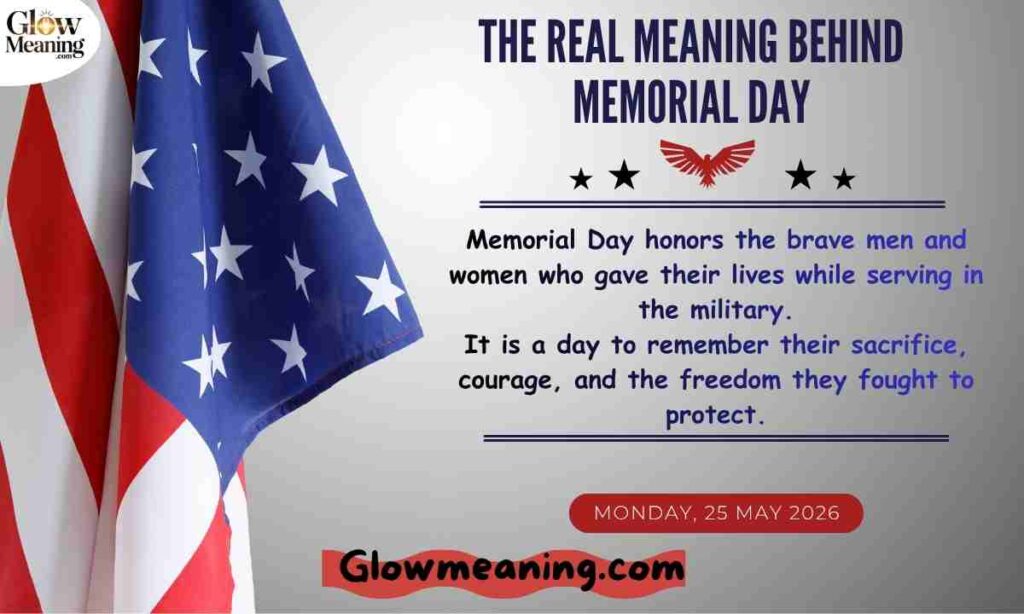
At its core, Memorial Day is about sacrifice. It’s not a celebration of war. It’s an acknowledgment that real people — sons, daughters, parents, and friends — left their families and never came home so that others could live freely.
The holiday is observed annually on the last Monday of May in the United States. It is a federal holiday, which means government offices, schools, and many businesses close to mark the occasion.
The direct answer to “what does Memorial Day mean” is this: it is a national day of mourning and gratitude for U.S. military personnel who died in service to their country. That’s it. That’s the whole purpose.
It’s not about thanking active-duty troops (that’s Armed Forces Day). It’s not about celebrating all veterans (that’s Veterans Day). Memorial Day is specifically and solemnly for those who did not come home.
What Was Memorial Day Originally Called?
Memorial Day was originally called Decoration Day.
On May 5, 1868, an organization of Union army veterans — the Grand Army of the Republic (GAR) — established Decoration Day as a time for the nation to decorate the graves of the war dead with flowers.
The name “Decoration Day” came directly from the act of decorating graves. Communities would gather, bring fresh flowers, and lay them across the burial sites of fallen soldiers. It was personal. It was quiet. It was grief turned into action.
In the 1880s, some began using the term “memorial” day in reference to the holiday. Following World War I, Memorial Day became the more commonly used term.
The word “memorial” shifted the tone slightly — from the physical act of decorating to the broader concept of remembrance. But the heart of the holiday never changed.
Why Memorial Day Is Celebrated Across America
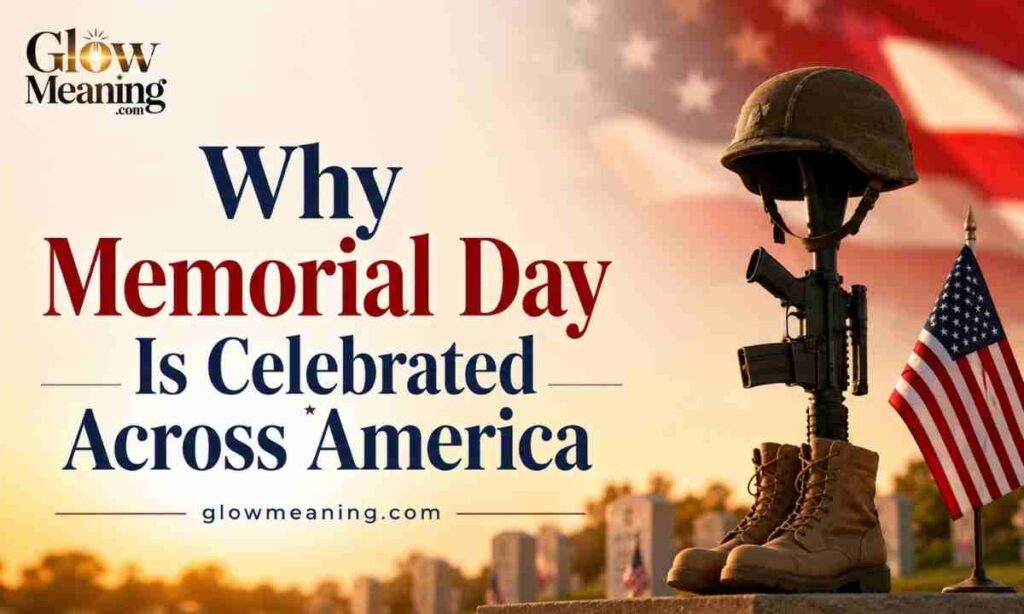
America celebrates Memorial Day because the country has sent its citizens into war many times — and many of them never returned. The holiday exists as a collective promise to those fallen soldiers: we will not forget you.
Memorial Day originally honored only those lost while fighting in the Civil War. But during World War I, the United States found itself embroiled in another major conflict, and the holiday evolved to commemorate American military personnel who died in all wars.
Today, the holiday encompasses every conflict — from the Revolutionary War to the wars in Iraq and Afghanistan. Over the centuries, more than 1.3 million Americans have died in military service. Memorial Day is their day.
It’s also a cultural moment. Families come together. Communities hold parades. Veterans gather at cemeteries. The holiday binds Americans across generations in a shared act of remembrance.
How Is Memorial Day Celebrated?
Celebrations vary by family and community, but some traditions are widely practiced:
- Visiting cemeteries to place flowers or small American flags on military graves
- Attending parades that feature veterans, military bands, and local organizations
- Observing a moment of silence at 3 p.m. local time
- Flying the flag at half-staff until noon, then raising it to full-staff until sunset
- Wearing red poppies as a symbol of the lives lost in service
Some families also hold private memorials or attend church services. The tone is one of gratitude mixed with grief — a bittersweet acknowledgment of what was given so others could live freely.
Memorial Day History
| Year | Event |
| 1865 | Freed slaves in Charleston, SC hold one of the earliest known memorial ceremonies |
| 1868 | General John A. Logan officially declares May 30 as Decoration Day |
| 1873 | New York becomes the first state to make it a legal holiday |
| 1880s | The term “Memorial Day” begins appearing informally |
| Post-WWI | Holiday expands beyond Civil War to honor all fallen U.S. soldiers |
| 1971 | Congress declares Memorial Day a federal holiday on the last Monday of May |
| 2000 | National Moment of Remembrance Act establishes the 3 p.m. pause |
The Emotional History of Memorial Day
The story of Memorial Day begins in the ruins of the Civil War — the deadliest conflict in American history.
The origins of Memorial Day date back to the Civil War, which claimed the lives of some 620,000 soldiers. In the aftermath, devastated communities sought to honor their dead.
Mothers, wives, and sisters were left behind. Entire towns lost a generation of young men. The grief was so widespread that communities across the country naturally began visiting graves and leaving flowers — not because anyone told them to, but because they didn’t know what else to do with their sorrow.
The earliest observance of what would become Memorial Day dates back to the spring of 1865, when a group of freed slaves in Charleston, South Carolina, held a ceremony to honor Union soldiers who had died in a local prison camp.
That ceremony — often overlooked in popular history — was one of the first formal acts of national remembrance after the war. It was a profound moment: people who had just gained their freedom choosing to honor those who had helped make it possible.
The emotional weight of those early ceremonies never really left the holiday. Even today, when you stand at a grave marker in Arlington National Cemetery, you feel it.
How Memorial Day Started in the United States
The GAR said Decoration Day should be observed on May 30 each year because the timing would permit flowers to be in bloom all over the country.
That practical detail — choosing a date when flowers would bloom — reveals something beautiful about the holiday’s founders. They wanted the act of remembrance to be living and colorful, not gray and cold. They wanted the graves to look like they belonged to people who were still loved.
The Grand Army of the Republic promoted the celebration of Decoration Day annually on May 30th. New York was the first state to make it a legal holiday in 1873. By 1890, all the states that fought for the Union had made Decoration Day a state holiday.
Southern states, for many years, observed their own separate memorial days for Confederate soldiers. It wasn’t until after World War I — when Americans of all backgrounds served and died together — that the holiday truly became a unified national observance.
It wasn’t until 1971, with the passage of the Uniform Monday Holiday Act, that Memorial Day was established as a federal holiday and moved to the last Monday in May to create a three-day weekend.
The shift to Monday was practical but controversial. Many veterans and historians argue that fixing it to a specific date — May 30 — carried more historical weight and kept the focus on remembrance rather than recreation.
The True Purpose of Honoring Fallen Soldiers
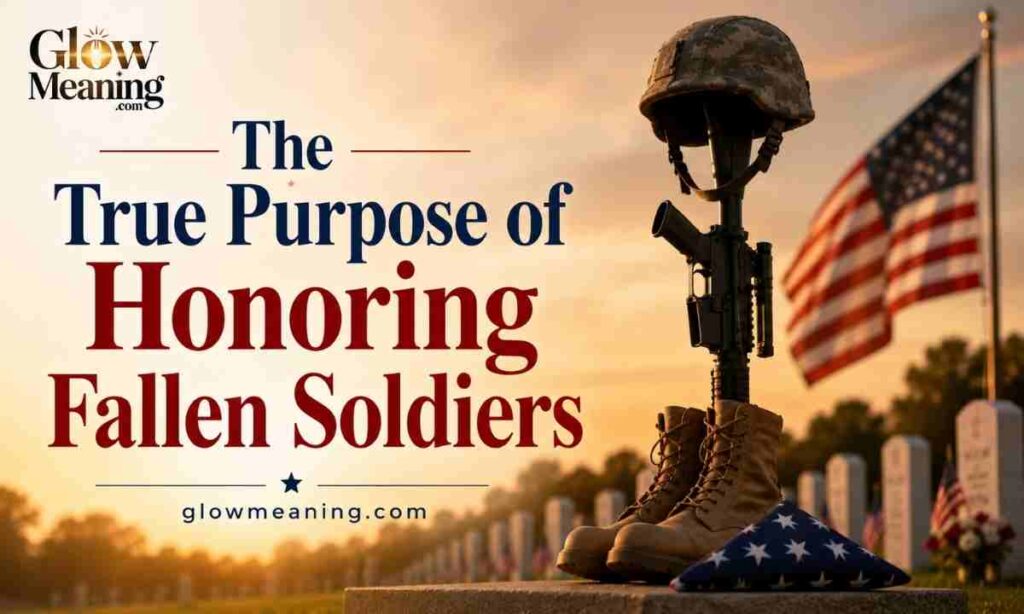
People sometimes ask: why does it matter to honor the dead? They’re gone. What difference does a parade or a flower make?
The answer is that remembrance isn’t really for the dead. It’s for the living.
When a community gathers at a cemetery on Memorial Day, it’s making a statement about its values. It’s saying: we believe that sacrifice matters. We believe that the people who gave everything for this country deserve to be named, seen, and remembered.
That act of collective memory is also a promise to future generations. It says: if you ever have to make that sacrifice, you will not be forgotten either.
Honoring fallen soldiers is how a nation keeps faith with itself.
It also reminds citizens that the freedoms they sometimes take for granted — free speech, the right to vote, the ability to worship or not worship as they choose — were not free. They were purchased, in some cases, with the lives of teenagers who had never even left their home state before enlisting.
Why Memorial Day Still Matters Today
In an age of social media and instant entertainment, a solemn holiday might feel out of place. But that’s exactly why Memorial Day matters more than ever.
It forces a pause. It asks people to look up from their phones, step away from their timelines, and think about something bigger than themselves.
In 2000, President Bill Clinton signed the National Moment of Remembrance Act, which encourages Americans to pause their Memorial Day activities at 3 p.m. local time to reflect on members of the armed forces who died while serving the country.
That one minute of silence at 3 p.m. is a powerful act. All across the country, at the same moment, millions of people stop whatever they’re doing and think about the same thing. There’s something quietly extraordinary about that.
Memorial Day also matters because new names are still being added to the list of the fallen. American service members continue to serve in dangerous places around the world. The holiday isn’t just history — it’s ongoing.
Is Memorial Day Always on a Monday?
Yes. Memorial Day is celebrated on the last Monday in May. This has been the official schedule since 1971. The date itself changes each year — it could fall anywhere from May 25 to May 31 — but it is always a Monday.
This setup creates the traditional three-day Memorial Day weekend, which, for many Americans, has become synonymous with the unofficial start of summer.
Common Memorial Day Traditions Americans Follow
While every family and community has its own way of marking the day, certain traditions have become deeply rooted in American culture:
Placing flags on graves — Volunteers, often veterans or Boy Scouts, place small American flags on the graves of service members at cemeteries across the country. At Arlington National Cemetery alone, thousands of flags are placed every year.
The wreath at the Tomb of the Unknown Soldier — National commemoration of the holiday at Arlington National Cemetery reflects the holiday’s earliest tradition: gravestones of the interred are decorated with American flags, while a wreath is placed at the Tomb of the Unknown Soldier.
Lowering the flag to half-staff — Per the VA, flags are to be flown at half-staff from sunrise until noon, then raised to the top of the staff until sunset.
Wearing red poppies — The poppy became a symbol of remembrance after World War I, inspired by the poem “In Flanders Fields.” Many Americans still wear them on Memorial Day.
Community parades — Towns and cities across the country hold parades featuring veterans, military units, marching bands, and local organizations.
The “Murph” workout — A popular modern tradition, especially in fitness communities, involves completing a challenging physical workout named after Navy Lieutenant Michael P. Murphy, who was killed in action in Afghanistan in 2005. It’s a way of honoring sacrifice through personal effort.
How Memorial Day Became a National Holiday
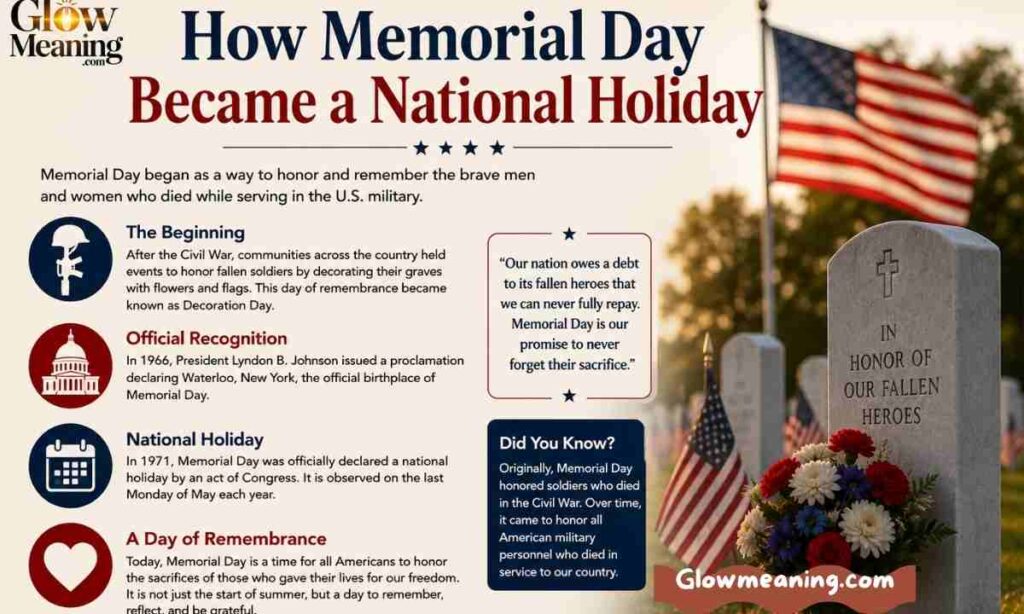
The journey from Decoration Day to a federally recognized national holiday took over a century.
The commemoration caught on across the nation, eventually expanding to become a broadly observed tradition. But for most of the 19th century, it remained a patchwork of state-level observances, with different states honoring the day differently — or not at all.
Gradually, Decoration Day came to be known as Memorial Day. That’s reflected in the 1887 law that Congress passed declaring ‘”Memorial” or “Decoration Day”‘ to be a holiday for all government employees.
The real turning point came after World War II and the Korean War, when the scale of American military sacrifice had grown so large that a unified, national observance felt not just appropriate but necessary.
It wasn’t until 1971, with the passage of the Uniform Monday Holiday Act, that Memorial Day was established as a federal holiday and moved to the last Monday in May to create a three-day weekend.
For a deeper look at the significance of symbolic gestures in American culture — like the blue and gray checkmarks you’ve probably seen online — you might also find this article helpful: What Do Two Check Marks Mean?
Memorial Day vs Veterans Day: What Makes Them Different
This is one of the most commonly confused distinctions in American holiday culture. The two holidays sound similar, but they serve very different purposes.
| Feature | Memorial Day | Veterans Day |
| Who it honors | Those who died in military service | All who served, living or deceased |
| When it’s observed | Last Monday in May | November 11 every year |
| Tone | Solemn, reflective, grief-oriented | Celebratory, grateful, recognition-focused |
| Primary tradition | Visiting graves, moments of silence | Parades, ceremonies, thanking veterans |
| When it became federal | 1971 | 1938 (as Armistice Day) |
Memorial Day is a solemn day of remembrance for the men and women who died while serving in the U.S. military. In contrast, Veterans Day is a celebration of all who have served in the armed forces, whether in wartime or peacetime, living or deceased.
A simple way to remember the difference: on Memorial Day, you remember. On Veterans Day, you thank.
While Memorial Day honors the fallen and Veterans Day honors all who have served, Armed Forces Day specifically celebrates those currently in uniform. Armed Forces Day falls on the third Saturday of May — so all three holidays come in relatively close proximity, which is another reason they sometimes get mixed up.
Is Memorial Day a Paid Holiday?
For most full-time employees of the federal government, Memorial Day is a paid federal holiday. Many state governments and large private employers also offer paid time off.
However, not all workers receive it. Part-time employees, contractors, and workers in certain industries — retail, healthcare, food service — may work on Memorial Day without automatic holiday pay. Whether you receive paid time off depends largely on your employer and employment contract.
Important Facts About Memorial Day Most People Don’t Know
Some aspects of Memorial Day’s history are rarely discussed in everyday conversation:
Waterloo, New York holds an official title. The federal government declared Waterloo, New York, the official birthplace of Memorial Day for starting the tradition of Memorial Day services in 1866.
Freed slaves helped start it. One of the earliest documented memorial ceremonies was organized by formerly enslaved people in Charleston, South Carolina in 1865 — a fact that rarely gets the attention it deserves.
The original date was May 30. Before the holiday was moved to create a three-day weekend, it was always observed on May 30. Some veterans and historians believe returning to a fixed date would restore the holiday’s solemn focus.
The red poppy has a literary origin. The tradition of wearing red poppies comes from the 1915 poem “In Flanders Fields” by Lieutenant Colonel John McCrae, written after he witnessed the death of a close friend in battle. Poppies grew wild across the graves in Flanders, Belgium.
The 3 p.m. pause is law. The National Moment of Remembrance is not just a suggestion — it was established by an act of Congress in 2000. At 3 p.m. local time, Americans are encouraged to pause for one minute of silence.
The Modern-Day Importance of Memorial Day
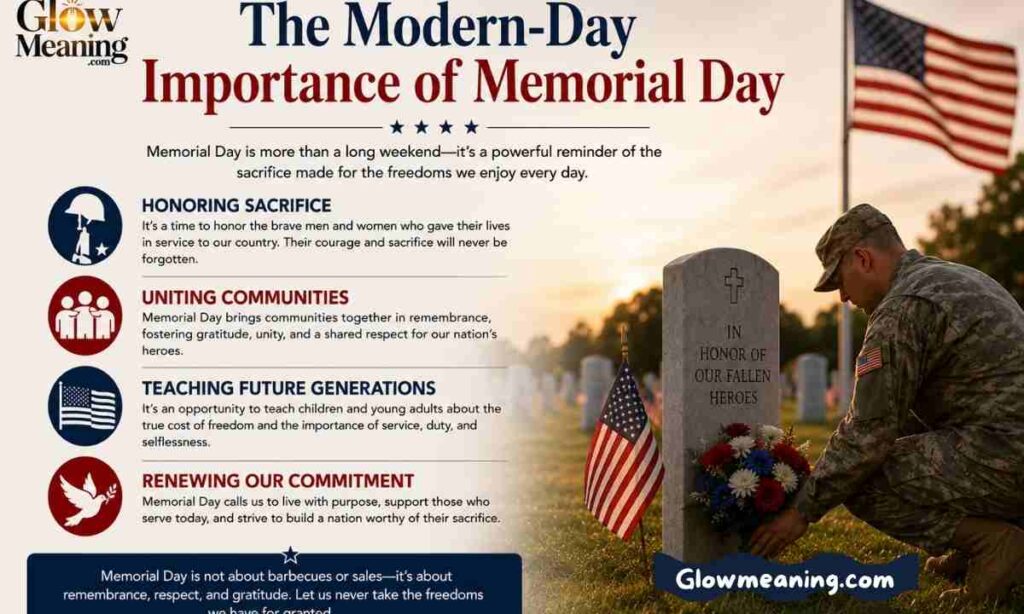
Memorial Day exists at an interesting crossroads in modern America. For many, it’s the start of summer. For others — especially Gold Star families who have lost a loved one in service — it is one of the most emotionally difficult days of the year.
Both experiences are real. And both can coexist.
You can enjoy a backyard cookout and still take one minute at 3 p.m. to stand quietly and remember. You can go to the beach and still drive past a cemetery with gratitude in your heart. The holiday doesn’t require grief — but it does ask for awareness.
It does give us the opportunity to focus on the real meaning of Memorial Day: to remember all those who died to keep our country free.
As the years pass and the wars of the 20th century grow more distant in living memory, the importance of actively choosing to remember only grows. Memorial Day is how America fights against forgetting.
For anyone wanting to explore the deeper cultural meanings behind symbols and gestures of remembrance, this piece on symbolic meanings offers a fascinating perspective on how small symbols carry outsized emotional weight.
You can also explore comprehensive historical context about this holiday through Britannica’s detailed coverage of Memorial Day, which traces its full evolution from post-Civil War grief to a modern federal observance.
Conclusion
Memorial Day is not just a long weekend. It is a conversation between the living and the dead a promise made across generations that the sacrifices of those who fell will never be forgotten. Every parade, every flag, every moment of silence is a small act of keeping that promise alive.
The next time Memorial Day comes around, take a moment to step beyond the cookout and really feel what the day is about. Think of the names on the headstones, the families who never heard a knock at the door but got a knock anyway, and the extraordinary ordinary people who chose to serve. They gave their tomorrows so you could have yours and that is worth more than a day off.

Professional content creator with 4+ years of experience in lifestyle, beauty, and meaningful digital storytelling through Glowmeaning.com.
