
If you’ve ever felt anger you never said out loud, you already understand the poison tree tattoo before you even get it inked. This design isn’t about villains or dark magic. It’s about something every single person on earth has lived through: swallowing your feelings until they grow into something bigger than you expected.
The poison tree tattoo meaning is rooted in one of the most quietly devastating poems in English literature, and once you understand where it comes from, the design takes on a whole new weight. This guide breaks down the symbolism, the poem behind it, the best design ideas, and what this tattoo really says about the person wearing it.
Tattoos rarely become timeless by accident. The designs that stick around, the ones people still ask about years later, usually carry a real story underneath the ink. That’s exactly why this particular symbol has stayed relevant for over two centuries it isn’t decoration first and meaning second. It works the other way around, which is part of why it keeps showing up on tattoo mood boards, literature blogs, and studio walk-in sheets alike.
Poison Tree Tattoo Meaning: Quick Answer
A poison tree tattoo represents repressed anger, hidden resentment, and the emotional consequences of bottling up feelings instead of expressing them. It’s inspired by William Blake’s 1794 poem “A Poison Tree,” where unspoken wrath grows into something toxic. For many wearers, the tattoo also symbolizes healing, self-awareness, and the choice to release anger before it poisons anything else.
That’s the short version. Now let’s dig into why this symbol has stuck around for over two centuries and why people are still choosing it as permanent art today.
What Does a Poison Tree Tattoo Mean?
At its core, a poison tree tattoo is a visual metaphor for emotional suppression. It shows what happens when a person chooses silence over honesty, again and again, until that silence takes root.
Most people who get this tattoo aren’t celebrating anger. They’re marking a turning point. It’s often chosen after:
- Ending a toxic relationship or friendship
- Working through years of unspoken resentment
- Learning (sometimes the hard way) that avoidance doesn’t make problems disappear
- Committing to therapy, journaling, or another form of emotional honesty
Think of it less like a warning label and more like a scar that healed into something meaningful. The tree isn’t glorified. It’s a reminder.
What Is the Meaning of a Poison Tree?
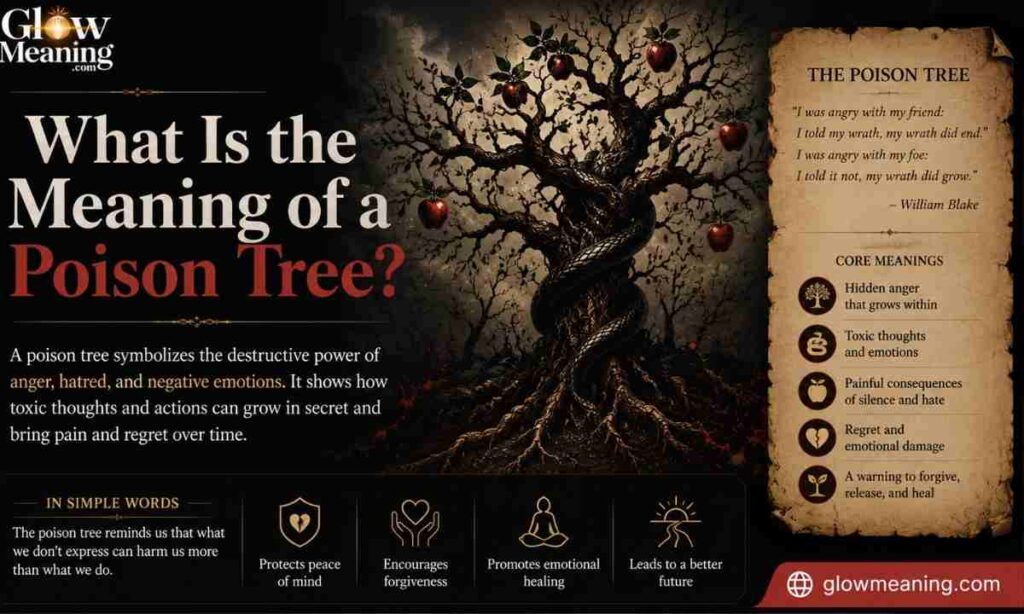
Symbolically, a poison tree represents anything that grows from a bad root and produces bad fruit. That idea shows up across cultures, folklore, and religious texts long before Blake ever picked up a pen.
In broad terms, a poison tree stands for:
- Consequences that grow slowly — nothing toxic happens overnight
- Hidden danger dressed up as something attractive — the “bright apple” effect
- A warning about what we nurture, emotionally or otherwise
It’s a universal image because everyone understands the basic mechanic: what you feed will grow, whether that’s love, grief, ambition, or anger.
The Origin of the Poison Tree: William Blake’s Poem
The phrase “poison tree” is almost always traced back to English poet and artist William Blake, who published “A Poison Tree” in 1794 as part of his collection Songs of Experience. The collection explores humanity’s fall from a state of grace, drawing heavily on biblical imagery, and nowhere is that allusion more powerful than in this particular poem about the deadly effects of unchecked anger.
Blake wasn’t just a poet he was also a painter and printmaker, and much of his work explored the darker, more complicated corners of human emotion rather than shying away from them. He’s often remembered as a visionary of the Romantic era whose imagination captured the innermost emotions of the human experience, which is part of why his 16-line poem still gets quoted, tattooed, and taught in classrooms more than 230 years later.
Here’s the basic setup of the poem, described rather than quoted directly:
The speaker describes being angry with a friend and simply telling them about it and the anger passes. But when the same anger arises toward an enemy, the speaker keeps it hidden instead. That buried anger gets “watered” daily with fear, sadness, and false smiles, until it grows into a tree that eventually produces a single, tempting apple. The enemy eventually eats the apple and dies, and the poem is widely read as an allegory for the danger of bottling up emotions and how doing so can spiral into a cycle of negativity or even violence
It’s a short poem, but it hits like a much longer one.
“A Poison Tree” Poem Meaning Explained
Scholars and readers have picked this poem apart for centuries, and a few interpretations keep surfacing again and again.
1. Anger needs an outlet. The poem contrasts two approaches to anger talking about it, which helps it pass, versus suppressing it, which allows it to grow uncontrolled. That contrast is the entire engine of the poem.
2. Wrath is self-created, not accidental. One analysis argues that the speaker purposefully nurtures his wrath, essentially growing the poison tree on purpose rather than being an innocent victim of circumstance . In other words, Blake isn’t just describing anger he’s describing the choice to keep feeding it.
3. Deception hides in daylight. The “soft deceitful wiles” and false smiles in the poem suggest that suppressed anger doesn’t just sit quietly it often disguises itself as politeness, which makes it even more dangerous to the person carrying it.
4. There’s a biblical echo running underneath. Many readers connect the poem’s imagery the tempting fruit, the garden, the fatal bite to the story of original sin in which gives the poem an extra layer of moral weight beyond a simple lesson about anger management.
5. Even the ending is unsettling. Later analysis of the poem’s closing lines points out something uncomfortable: the speaker reports feeling glad, not guilty, once the foe lies dead beneath the tree. That small emotional detail is often what makes tattoo fans connect with the poem it doesn’t sugarcoat how satisfying suppressed anger can feel once it “wins,” even while showing you exactly how destructive that satisfaction is.
Put simply: this isn’t a poem about hating your enemy. It’s a poem about what happens inside you when you refuse to deal with them honestly.
What makes the poem so quotable, even after more than two centuries, is how ordinary the setup feels. Nearly everyone has been angry at a friend and talked it out over coffee, and nearly everyone has also swallowed anger toward someone they didn’t feel safe confronting. Blake doesn’t moralize about which choice is “right” in a heavy-handed way he simply shows the outcome of each path and lets the reader draw their own conclusion. That restraint is part of why the poem translates so naturally into tattoo form: it’s already a visual story before anyone puts it on skin.
Core Symbolism of a Poison Tree Tattoo
Here’s a quick breakdown of what different parts of the design tend to represent:
| Design Element | Common Symbolic Meaning |
| Twisted, gnarled branches | Years of unresolved anger or resentment |
| A single glowing apple | Temptation, deception, or a “trap” hidden in something attractive |
| Bare or dead roots | Emotional numbness or repression |
| New leaves alongside dead ones | Healing while still carrying old pain |
| A snake wrapped around the trunk | Betrayal, temptation, or biblical original sin |
| Dark, inky shading | The weight of secrecy and buried emotion |
Most people don’t use every element. A lot of the best tattoos pick just one or two symbols and let the rest of the design breathe.
Tattoo artists who specialize in symbolic or literary work often say the strongest versions of this design tell a story with restraint rather than crowding the skin with every possible detail. A single apple hanging from a bare branch can say just as much as a full scene with a snake, a garden wall, and a figure lying beneath the tree sometimes more, because the viewer’s imagination fills in the rest.
It’s also worth noting that symbolism can shift slightly depending on culture and personal experience. For some wearers, the tree leans more toward a warning to themselves a visual cue not to repeat old patterns. For others, it’s aimed outward, a quiet acknowledgment of a specific relationship or falling-out that shaped who they are today.
Learn what TS means in text messaging, Snapchat, TikTok, and social media, including its most common meanings and real-life examples.
Poison Tree Tattoo Meaning for Women
For women, this tattoo often represents releasing what no longer serves them a toxic relationship, a friendship that quietly turned sour, or years of being told to “just be nice” instead of being honest about hurt feelings.
It’s frequently chosen as a quiet, personal statement rather than a decorative one. Common placements and styles for women include:
- Delicate linework versions along the spine or ribs
- Small, minimalist trees on the wrist or ankle
- Watercolor versions that soften the darker theme with color
The meaning doesn’t change much by gender, but the visual execution often leans more subtle and detailed.
A lot of women describe choosing this design at a specific turning point after finally setting a boundary they’d avoided for years, or after realizing a pattern of staying quiet had cost them more than speaking up ever would. The tattoo becomes less about the person who hurt them and more about the version of themselves that finally stopped absorbing it silently.
Some also pair the tree with small additional symbols, like a single bird flying away from the branches or a crescent moon tucked into the background, to represent moving forward rather than staying stuck in the story.
Poison Tree Tattoo Meaning for Guys
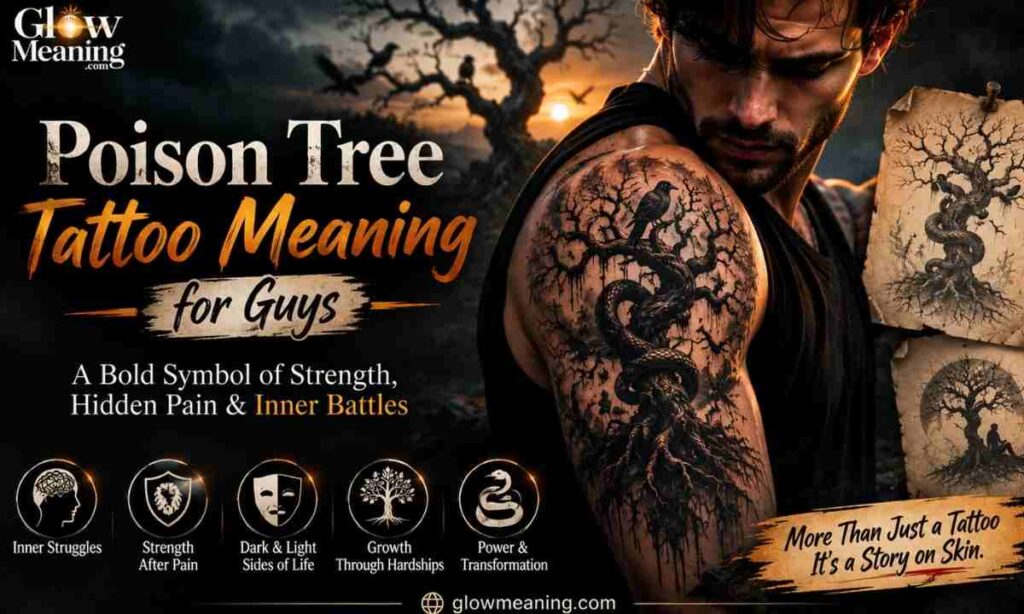
For men, the tattoo tends to lean into strength through restraint the idea that real power isn’t losing your temper, it’s learning what to do with anger instead of letting it quietly rot.
Popular choices for guys include:
- Bold black-and-grey pieces on the forearm or calf
- Larger back or chest pieces incorporating the full “Blake narrative” (tree, apple, sometimes a figure beneath it)
- Sleeve additions paired with other literary or gothic imagery
Because the poem itself deals with rivalry and hidden conflict, plenty of men connect with it as a symbol of choosing maturity over pride.
There’s also a generational shift worth mentioning here. Older tattoo traditions leaned heavily on outward toughness skulls, daggers, aggressive imagery. A poison tree tattoo flips that script a little. It signals emotional self-awareness instead, which is part of why it’s gained popularity among men who want a piece with genuine depth rather than surface-level intimidation.
Guys who pair it with other Blake-inspired work, like lines or imagery from Songs of Innocence and Experience, often use the combination to build a larger, more personal narrative across an entire sleeve rather than treating it as one standalone piece.
Poison Tree Tattoo Meaning: Strength, Growth & Healing
Here’s the part people often miss: this tattoo isn’t only about the dark side of the story. For a lot of wearers, it’s actually a healing symbol.
Getting a poison tree tattoo can represent:
- Acknowledging past anger without being ruled by it anymore
- Choosing honesty as a daily practice instead of silence
- Marking growth — literally, since trees are a growth symbol in almost every culture
- A permanent reminder to speak up before resentment has time to take root
Some people even design the tree with one side blooming and the other side bare, showing both the damage anger can cause and the new growth that comes after choosing to deal with it differently.
This is arguably the most overlooked part of the poison tree tattoo meaning. Because the poem itself ends on such a dark note, people assume the tattoo has to carry that same weight forever. In practice, most wearers treat it more like a “before and after” marker the poem shows what happens when you don’t deal with anger, and the tattoo becomes a personal promise to do it differently going forward.
Therapists who work on emotional regulation sometimes describe anger as something that needs a healthy outlet rather than a lid. A poison tree tattoo, in that sense, functions almost like a permanent sticky note: a visible reminder that silence has a cost, and that speaking up earlier is almost always cheaper in the long run.
Who Chooses a Poison Tree Tattoo—and Why?
This design tends to attract a specific type of person, and it’s rarely someone chasing a trend. Common reasons people give include:
- Literature lovers who want a piece connected to a favorite poet or poem
- People in recovery from a toxic relationship, romantic or otherwise
- Therapy-goers marking real emotional progress
- Gothic and dark-aesthetic tattoo fans who are drawn to the visual style regardless of the deeper meaning
- Writers and artists who relate to Blake’s work as a creative influence
It’s a tattoo that works on two levels it looks striking even if someone has no idea about the poem, but it means something entirely different once they do.
That double meaning is a big part of the appeal. Someone can compliment the artwork on the bus without ever knowing it represents years of unspoken anger finally being put to rest. The wearer gets to decide how much of the story they want to share, and with who — which is rare for a visible tattoo.
It also tends to age well emotionally. Unlike trend-driven tattoos that can feel dated a few years later, a poison tree tattoo is tied to a fixed piece of literature rather than a passing aesthetic, so the meaning behind it doesn’t really shift over time the way pop-culture references sometimes do.
Popular Poison Tree Tattoo Design Ideas
Black & Grey Gothic
This is the most popular style by far. Heavy shading, twisted branches, and a moody, almost haunted-forest feel. It suits larger placements like the back, thigh, or full forearm, and it holds up especially well over time since black-and-grey work tends to age more gracefully than heavily saturated color pieces.
Half-Dead, Half-Living Tree
One side of the tree looks withered and bare, the other side blooms. This is a favorite for people who want the “healing” meaning to be visually obvious without needing to explain it to anyone who asks. It also gives an artist room to play with contrast sharp, jagged linework on the dead side against soft, rounded shapes on the living side.
Serpent & Apple Design
Adding a snake coiling around the trunk leans into the Genesis connection and adds a temptation-and-consequence layer to the piece. This version tends to appeal most to people drawn to religious or mythological symbolism generally, not just Blake’s poem specifically.
Minimalist Poison Tree Tattoo
Simple line-art versions, sometimes just a small silhouette, are popular for first tattoos or for people who want the meaning without a large visual statement. These designs work particularly well as a first tattoo because they’re less intimidating to commit to and easier to build on later if the wearer decides to expand the piece down the road.
Watercolor Poison Tree Tattoo
Softer, painterly color washes turn the dark theme into something that reads as more artistic than ominous popular for smaller, more personal placements like the shoulder or upper arm. This style trades some of the gothic weight for a more emotional, almost dreamlike quality.
Blake-Inspired Artwork
Some people go a step further and incorporate Blake’s own illustrative style (he was a printmaker, after all), using etching-style linework to nod directly to the poet himself. This is the most literature-forward option and tends to appeal most to readers and writers who want the tattoo to double as a tribute to Blake’s broader body of work, not just this one poem.
Color Meanings in Poison Tree Tattoos
| Color | Symbolic Meaning in This Design |
| Black & grey | Classic, moody, emphasizes secrecy and weight |
| Deep red (apple only) | Danger, temptation, buried anger |
| Green | Growth, healing, moving forward |
| Purple | Mystery, transformation |
| Muted watercolor tones | Softness, personal reflection rather than warning |
Most tattoo artists will tell you: keep the palette limited. Two or three tones usually read cleaner than a full-color piece for this particular theme.
Color choice can also shift the emotional tone of the same exact design. A black-and-grey tree with one red apple reads as ominous and restrained, while the same tree rendered in green and gold leans warmer, almost hopeful, even though the underlying meaning hasn’t changed at all. If you’re unsure which direction fits your story, ask your artist for a quick digital mockup in two or three color variations before committing most studios can turn this around in a single consultation.
Best Placement Ideas for a Poison Tree Tattoo
Placement often depends on how big and detailed you want the design to be.
- Forearm — great for medium detail, easy to show or cover
- Back or shoulder blade — ideal for larger, more elaborate scenes with the full tree, apple, and snake
- Ribs or spine — a popular choice for more private, symbolic pieces
- Calf or thigh — plenty of space for a tall, dramatic tree silhouette
- Wrist or ankle — best for minimalist versions
If the design includes fine linework or text from the poem, choose a placement with smoother skin and less movement, like the forearm or upper back, so the detail holds up over time.
It’s also worth thinking about visibility. Some wearers want this tattoo to spark conversation, so they choose the forearm or calf on purpose. Others want it to stay private, reserved only for people they choose to tell the story to, and go with ribs, spine, or upper thigh placements instead. Neither choice is more “correct” it just depends on whether the meaning is something you want to explain often or keep close.
Talk placement through with your artist before booking, especially for larger scenes. A skilled tattooer will often suggest adjusting the tree’s shape slightly to follow your body’s natural lines, which helps the piece look intentional rather than stretched or cramped.
Psychological & Spiritual Meaning of a Poison Tree Tattoo
Psychologically, this tattoo often functions as a daily check-in. Seeing it reminds the wearer to notice anger early, before it has time to “root.”
Spiritually, many wearers connect it to broader ideas of consequence and cause-and-effect what you nurture in silence eventually shows up in your life, one way or another. It doesn’t need to be tied to a specific religion to carry that weight; the basic principle shows up across nearly every belief system in some form.
For some, it’s simply a tribute to their favorite poet. For others, it’s closer to a quiet vow: I will not let this happen to me again.
There’s also a psychological concept worth mentioning here: the idea that naming a feeling reduces its power over you. That’s essentially what Blake describes in the poem’s opening lines anger spoken to a friend simply ends, while anger left unspoken keeps compounding. A poison tree tattoo can act as a permanent, physical version of that same lesson, worn as a reminder rather than just read once and forgotten.
Spiritually inclined wearers sometimes take it a step further, viewing the tattoo as a form of accountability to a higher standard a promise not to let hidden resentment shape their choices, even when no one else would know the difference.
Common Misunderstandings About the Poison Tree Tattoo
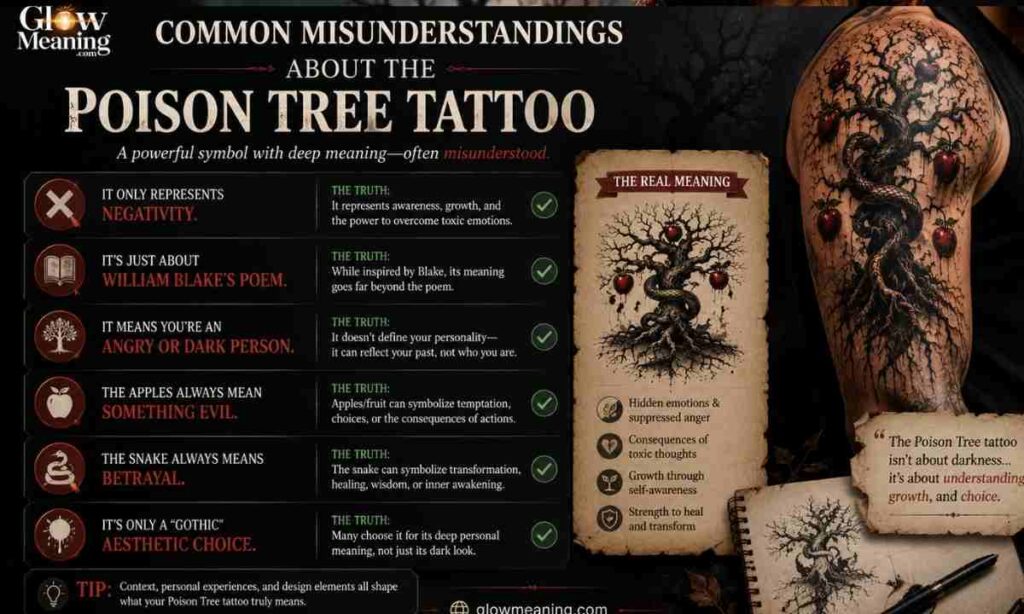
A few myths tend to follow this design around, so let’s clear them up.
- “It’s just a dark, evil symbol.” Not really the meaning is almost always about self-awareness, not villainy.
- “It means the wearer is angry all the time.” Usually the opposite. Most people get it after learning to manage anger better, not while struggling with it.
- “It has to include the apple to count.” Not true. Plenty of meaningful versions skip the apple entirely and focus on the tree itself.
- “It’s only for people who’ve read the poem.” Many wearers discover the poem after falling in love with the visual first, and that’s completely valid.
- “It’s a curse symbol or associated with witchcraft.” This confusion sometimes comes from unrelated folklore about literal poisonous plants. The tattoo’s actual meaning traces back to Blake’s poem about human emotion, not folk magic.
- “It’s always paired with skulls or death imagery.” While some gothic versions do lean that way, plenty of designs keep the theme entirely botanical, with no death imagery at all beyond the metaphor itself.
Understanding these distinctions matters, especially if you’re explaining the tattoo to family members or coworkers who might jump to conclusions based on the name alone. Once people hear the actual story behind it, the reaction almost always shifts from confusion to genuine curiosity.
Frequently Asked Questions
What does a poison tree tattoo symbolize?
It symbolizes repressed anger and the consequences of staying silent instead of expressing your feelings honestly.
Is the poison tree tattoo based on a real poem?
Yes. It’s based on William Blake’s 1794 poem “A Poison Tree” from his collection Songs of Experience.
Is a poison tree tattoo a bad omen?
No. It’s generally seen as a personal, reflective symbol rather than a curse or bad-luck design.
What does the apple mean in a poison tree tattoo?
The apple represents temptation and hidden danger something that looks appealing on the surface but carries consequences underneath.
Can a poison tree tattoo represent healing instead of anger?
Absolutely. Many people choose it specifically to mark growth, therapy progress, or the decision to stop bottling up emotions.
What’s a good placement for a poison tree tattoo?
The forearm, back, or calf work well for detailed designs, while the wrist or ankle suit smaller, minimalist versions.
Does the poison tree tattoo have religious meaning?
It can. Many interpretations link it to the Genesis story of forbidden fruit, though the core meaning stays focused on anger and consequence.
Final Thoughts: Is a Poison Tree Tattoo Right for You?
If you’ve ever felt anger grow quieter on the outside while getting heavier on the inside, this tattoo speaks a language you already know. It’s not about staying angry it’s about remembering what happens when you don’t deal with it at all.
Whether you choose a bold gothic tree or a small, minimalist branch on your wrist, the meaning travels with you either way. It’s a design that rewards a second look, both from the person wearing it and everyone who takes the time to ask what it means.

Professional content creator with 4+ years of experience in lifestyle, beauty, and meaningful digital storytelling through Glowmeaning.com.
