
If you’ve searched for the Tristan meaning in Greek, you’re definitely not alone. It’s one of the most common questions parents and name lovers ask, and the real answer might surprise you. Tristan isn’t actually a Greek name at all but its story is even more fascinating than a simple Greek translation.
In this guide, we’ll walk through where Tristan truly comes from, why so many people connect it to Greek, and what it means across different cultures, languages, and even the Bible. We’ll also cover its history, its most famous legend, and why it remains such a beloved choice for parents today.
Along the way, we’ll look at how the name has traveled across centuries and countries, picking up new meanings and associations at every stop. It’s a great case study in how names evolve, and why the “true” meaning of a name isn’t always the one that ends up sticking in popular imagination. By the end, you’ll know exactly how to answer anyone who asks about this beautiful, timeless name.
What Does Tristan Mean in Greek?
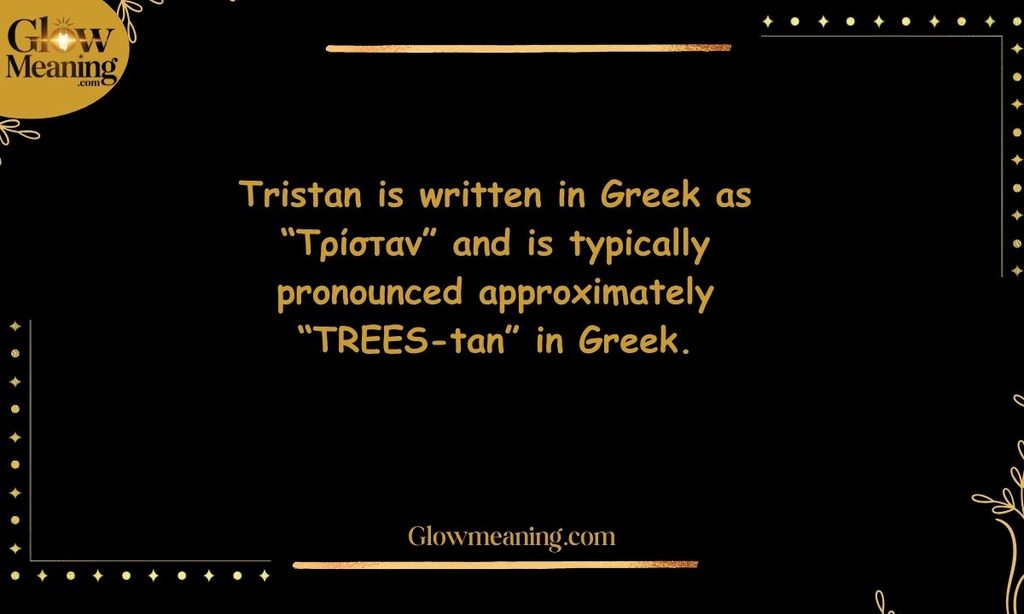
Here’s the short, direct answer: Tristan has no meaning in Greek because it isn’t a Greek name. It doesn’t appear in ancient Greek mythology, literature, or language records, and you won’t find it in any classical Greek dictionary or lexicon.
The confusion usually happens because Tristan sounds like it could be Greek. Many Greek names end in similar syllables, and the name has a classical, romantic ring to it that makes it feel like it belongs alongside names like Alexander or Theodore. But sound alone doesn’t equal origin.
Tristan actually comes from Celtic and Pictish roots, later shaped by Old French. It’s a great reminder that a name’s vibe and its true linguistic history can be two very different things. We’ll break down exactly how that happened in the next few sections.
This kind of mix-up happens more often than people realize. Search engines and voice assistants get asked questions like “Tristan meaning in Greek” every single day, which tells us the myth has spread widely online. Understanding the real answer helps set the record straight, and it also gives you a much richer story to share if you’re naming a child, writing a paper, or just satisfying your own curiosity about where the name came from.
Tristan Name Meaning and Origin
Tristan is widely believed to be a boy’s name of Celtic origin, tracing back to the Pictish name Drust or Drustan. Over time, this evolved through Welsh (Drystan) and later into the French form we recognize today.
There are two meanings commonly tied to Tristan:
- “Tumult” or “noise” from the ancient Pictish root drest
- “Sad” or “sorrowful” from the Old French word triste
Most name historians agree the “sad” meaning came later, likely influenced by the tragic legend of Tristan and Isolde rather than the name’s original roots. This is actually a pretty common pattern in name history a name’s meaning shifts as it travels through different languages and cultures.
In short: Tristan’s true meaning is closer to “riot” or “clamor” from its Celtic base, though it’s popularly known today as meaning “sorrowful.” Both meanings tell a story, which is part of why the name feels so rich and layered.
It’s worth noting that name meanings for very old names are rarely simple. Because Tristan passed through several languages Pictish, Welsh, and then French before reaching English, its meaning was reshaped at each step. This layered history is actually one of the more interesting parts of the name, since it means Tristan carries echoes of several cultures rather than just one.
Is Tristan a Greek Name?
No, Tristan is not a Greek name. It belongs to the Celtic and Brythonic language family, with strong ties to ancient Pictish Scotland and later Welsh and French culture.
Greek names typically trace back to Ancient Greek roots like -dorus (gift), -philos (love), or -polis (city). Tristan doesn’t share any linguistic connection to these patterns, and no credible etymology dictionary lists it as Greek.
That said, plenty of parents mistakenly assume Tristan is Greek simply because it feels mythological and dramatic — much like names such as Orion or Damon, which actually are Greek. It’s an easy mix-up, but not an accurate one. If you want a name with genuine Greek roots and a similar dramatic feel, names like Theron or Atticus might be worth exploring instead.
Another reason for the confusion is that many baby name apps and quick-answer websites publish short, unverified snippets that get repeated across the internet without fact-checking. Once a claim like “Tristan is Greek” appears on enough low-quality sites, it starts to feel true simply because it’s everywhere. That’s exactly why it helps to check original etymology sources rather than relying on a single quick search result.
Tristan Meaning in Greek: Meaning vs. Actual Origin
Let’s clear up the difference between what people think Tristan means and what it actually means historically.
| Category | Common Belief | Actual Origin |
| Language family | Greek | Celtic/Pictish |
| Popular meaning | “Sad” | “Tumult” or “noise” |
| Cultural link | Greek mythology | Arthurian/Celtic legend |
| First recorded use | Ancient Greece | Early medieval Britain |
| Modern transliteration | N/A | Written as Τρίσταν in Greek |
This table shows why the Greek connection is really a folk belief, not a documented fact. It’s a great example of how a name’s popular meaning can drift far from its true linguistic history, especially once a name becomes famous through literature and legend rather than everyday language.
The Etymology and Historical Origin of Tristan
The name’s earliest traceable form is Drust, a name used by several early Pictish kings in what’s now Scotland. Adding the diminutive suffix “-an” created Drustan, meaning something like “little Drust” or a familiar form of the name.
In Welsh sources, this became Drystan, and the name carried associations with the drest root, tied to ideas of noise, uproar, or tumult. Some historians even connect the name to an old legend about a Pictish king who defeated a giant, which may have helped the name spread across Britain.
By the 12th century, French poets writing the legend of Tristan and Isolde had reshaped the name into Tristan, likely blending it with the Old French word triste (“sad”). This gave the name its now-famous sorrowful meaning, even though that wasn’t its original sense at all.
Interestingly, name researchers have found records of a “Tristan” witnessing a legal document at the Abbey of Saint Gall in the year 807, showing the name was already circulating in Europe centuries before the famous romance made it a household name.
Linguists such as Sigmund Eisner have also traced the legend itself back to early Celtic monastic writers in North Britain, who may have blended local Pictish folklore with older Greek and Roman storytelling traditions they encountered through religious texts. This doesn’t make Tristan a Greek name, but it does help explain why the finished legend feels so universal, almost like it could belong to any culture that loves a good tragic love story.
The Story of Tristan and Isolde
No discussion of Tristan’s meaning is complete without the legend that made it famous. Tristan and Isolde is one of medieval Europe’s greatest love stories, first told in French and later expanded across English and German literature.
In the tale, Tristan is sent by his uncle, King Mark of Cornwall, to bring back Isolde (or Iseult), an Irish princess meant to become the king’s bride. During the journey, the two accidentally drink a love potion and fall passionately, tragically in love.
Their forbidden romance ends in heartbreak and death, cementing Tristan’s name forever with themes of devotion, sacrifice, and sorrow. It’s a story that has been retold so many times, in so many forms, that it almost feels like it belongs to every culture rather than just one.
Key points about the legend:
- Believed to originate from 12th-century French poems by Béroul and Thomas of Britain
- Later included in Le Morte d’Arthur, where Tristan becomes a Knight of the Round Table and close friend of Lancelot
- Inspired countless works of art, opera (most famously Wagner’s Tristan und Isolde), and literature
- Continues to influence modern books, films, and even video games that draw on Arthurian themes
This story is the real reason Tristan feels so “Greek-tragedy” in spirit, even though it has zero connection to actual Greek mythology.
What makes the legend so enduring is how universally relatable it is. Forbidden love, family loyalty, and impossible choices are themes that show up across nearly every culture’s storytelling tradition, which is exactly why Tristan’s tale has been retold in French, German, English, and beyond, each version adding its own regional flavor while keeping the emotional core intact.
Tristan and the Greek Language: Is There a Connection?
There’s no linguistic bridge between Tristan and the Greek language. Tristan doesn’t derive from Greek roots, doesn’t appear in Greek texts, and has no equivalent meaning drawn from Greek vocabulary.
The closest thing to a “connection” is thematic, not linguistic. Greek mythology is full of tragic love stories think Orpheus and Eurydice, or Pyramus and Thisbe and Tristan’s tale shares that same emotional DNA. Some scholars even believe the medieval authors who first wrote the Tristan legend were familiar with these older Greek and Roman stories and borrowed elements from them.
That similarity in feeling, rather than language, is likely why people search for a Greek meaning in the first place. If you love the emotional weight of Greek tragedy but want a name with real Celtic roots, Tristan gives you both worlds without actually being Greek.
How Is Tristan Written and Pronounced in Greek?
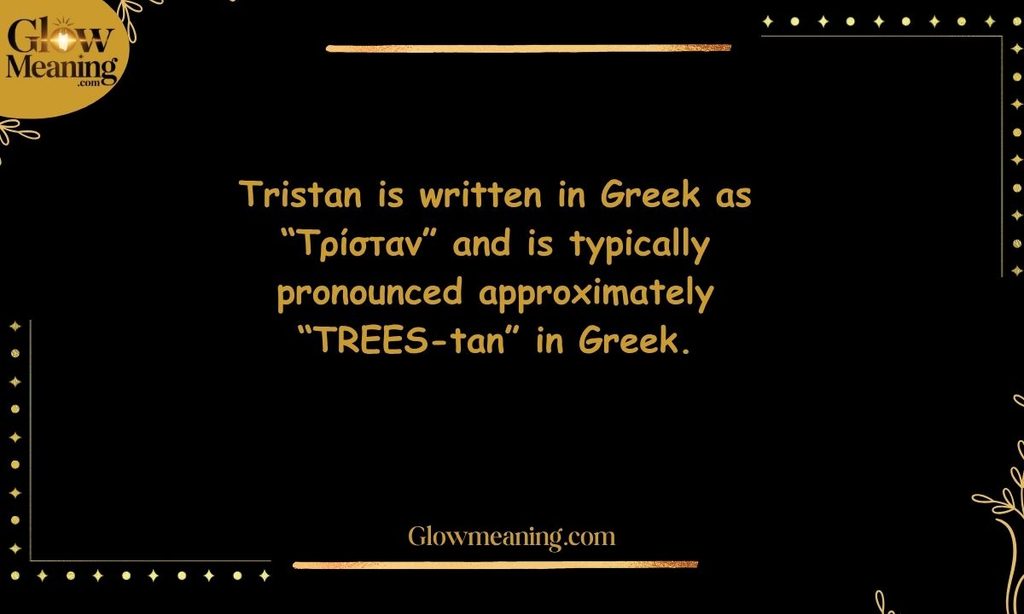
Even though Tristan isn’t originally Greek, it can still be transliterated into the Greek alphabet for practical purposes, such as writing the name on documents, invitations, or in Greek-speaking communities.
- Greek spelling: Τρίσταν
- Pronunciation: TRIS-tan (very close to the English pronunciation)
- Alternate transliteration: Τριστάν
- Stress pattern: Falls on the first syllable, just like in English
This is simply a phonetic conversion, not evidence of Greek origin. Many non-Greek names get transliterated this way for use in Greek-speaking countries, the same way English names are often adapted into other alphabets around the world.
Transliteration is purely about matching sounds between two writing systems, not about tracing a name’s true history. A name like Tristan can be transliterated into Greek, Russian, Arabic, or Japanese just as easily, and none of that changes its actual Celtic origin one bit.
You can also learn what OTW means in text messages and how it is commonly used in online conversations.
Is Tristan Found in Greek Mythology?
No, Tristan does not appear anywhere in Greek mythology. You won’t find him among the Greek gods, heroes, or figures from Homer’s epics like the Iliad or the Odyssey.
Some people confuse Tristan with Greek mythological figures because of the name’s dramatic, legendary feel but this is a modern association, not a historical one. Tristan’s mythology is rooted in Arthurian and Celtic legend, centuries after Greek mythology was already well established across the ancient world.
If you’re specifically looking for names tied to Greek mythology, options like Achilles, Perseus, or Atlas would be a more accurate fit than Tristan, since each of those names has a documented origin straight from ancient Greek texts and legends.
Tristan Meaning in the Bible
Tristan does not appear in the Bible, in either the Old or New Testament. It’s not a biblical name in the traditional sense, unlike names such as David, Sarah, or Michael, which have direct scriptural roots.
However, many parents today choose Tristan alongside a biblical middle name to blend classic literary charm with spiritual meaning. This has become a popular naming strategy, especially for families who love the sound of Tristan but want a scriptural connection somewhere in the name, such as Tristan Noah or Tristan Gabriel.
This approach lets families enjoy the best of both worlds: a first name rich in literary romance and a middle name grounded in faith and tradition. It’s a common pattern seen across many modern baby name choices, not just with Tristan.
Learn the Tristan name meaning, including its origin, history, and cultural significance.
Is Tristan a Biblical Name?
No, Tristan is not considered a biblical name. It has no Hebrew, Aramaic, or Greek biblical roots and doesn’t appear in any translation of scripture, including the Septuagint or the Latin Vulgate.
Its origins are entirely secular and rooted in medieval European legend, not religious texts. If biblical meaning matters to you, pairing Tristan with a strong middle name like Tristan James or Tristan Elias is a popular workaround that many families use.
Tristan Meaning in Hebrew
Tristan has no meaning in Hebrew either, since it isn’t derived from the Hebrew language. There’s no Hebrew root word that connects to Tristan’s sound or spelling, and it doesn’t appear in any Hebrew name registries or biblical name lists.
Some naming sites incorrectly attach spiritual or Hebrew meanings to popular names for SEO purposes, but genuine etymological research shows Tristan’s roots are firmly Celtic and later French not Hebrew. It’s always worth double-checking claims like this against reputable etymology sources, since misinformation about name origins spreads quickly once it’s published online.
If you’re drawn to Hebrew names specifically, options like Ezra, Levi, or Noah carry genuine Hebrew roots and meanings, unlike Tristan, which simply doesn’t have a linguistic connection to that language family.
Is Tristan Greek, Celtic, or Biblical?
To settle this once and for all, here’s a clear breakdown:
| Origin Type | Is Tristan Connected? |
| Greek | No |
| Celtic/Pictish | Yes — this is the true origin |
| Biblical/Hebrew | No |
| French (later influence) | Yes — shaped the modern spelling and “sad” meaning |
| Welsh | Yes — appears as Drystan |
| Latin | Only indirectly, through Latinized records like “Drustanus” |
Tristan is a Celtic name with French literary influence, not a Greek or biblical one. This is the most historically accurate classification according to name etymologists and language historians who have studied medieval manuscripts.
Spiritual Meaning and Symbolism of Tristan
While Tristan isn’t tied to any specific religion, many people find spiritual meaning in the name’s themes of love, loyalty, and sacrifice.
- Devotion — Tristan’s legend centers on unwavering loyalty, even under impossible circumstances
- Resilience — the name carries a quiet strength despite its sorrowful backstory
- Passion — often associated with deep, intense emotional connection
- Sacrifice — Tristan’s story shows a willingness to give everything for love and honor
For parents who love symbolic naming, Tristan represents a soul who loves fully and faces hardship with courage a meaningful message to carry through life, regardless of religion or culture.
Some naming traditions also connect Tristan to the idea of transformation, since the character in the legend grows from a young warrior into a figure defined by love and sacrifice. This arc of growth is something many parents find meaningful when choosing a name that they hope will reflect their child’s own journey through life.
Cultural Significance of the Name Tristan
Tristan holds a special place in European literary and cultural history, especially in Britain, France, and Wales.
- In Cornwall and Brittany, the name is tied to local Arthurian heritage and is considered a native hero’s name
- In Wales, the native form Drystan appears in medieval manuscripts like Ystorya Trystan
- In Germany, Tristan gained fame through Wagner’s opera Tristan und Isolde, one of the most celebrated works in classical music
- In modern pop culture, the name appears in films, books, and even reality TV, keeping it culturally relevant today
- In France, Tristan remains a well-used classic name, still associated with romance and chivalry
This wide cultural footprint is part of why Tristan feels timeless rather than trendy, appealing to families across many different backgrounds.
Beyond Europe, Tristan has also found a home in American and Latin American naming traditions, often chosen for its romantic sound rather than any specific regional connection. This kind of cross-cultural adoption is common with names that carry strong literary weight, since the story behind the name often matters more to parents than the name’s exact geographic origin.
University of Copenhagen – Tristan very good academic/educational source. It discusses Tristan’s Celtic/Pictish origin and connection with tristis (“sad”)
Tristan Name Variations and Related Names
If you love Tristan but want something slightly different, there are several beautiful variations across languages:
- Drystan (Welsh)
- Tristán (Spanish)
- Tristão (Portuguese)
- Tristano (Italian)
- Trystan (modern Welsh spelling)
- Trestan (rare modern variant)
Related names with similar sound or feeling include Tobias, Damian, and Sebastian all names with strong historical roots and a slightly dramatic edge. If you like Tristan’s romantic, legendary quality, you might also enjoy names like Lancelot, Gawain, or Merlin, which share the same Arthurian world.
Each variation carries its own regional flavor while staying connected to the same Celtic root. Choosing a variation like Tristán or Tristão can be a lovely way to honor a family’s Spanish or Portuguese heritage while still keeping the classic sound and legendary backstory intact, and it’s a simple way to make a well-known name feel a little more personal to your own family history.
Is Tristan a Popular Name Today?
Yes, Tristan remains a consistently popular choice for parents in the United States and beyond. It regularly ranks among the top 200–300 boy names nationally, and it has held that steady position for many years without major spikes or drops.
- Tristan has stayed fashionable for decades, unlike many trend-driven names that fade quickly after a burst of popularity
- It works well as both a classic and modern-sounding choice, which helps it appeal across generations
- Celebrities like Chris Hemsworth have helped keep the name in the public eye, having named one of his sons Tristan
- It’s occasionally used as a name for girls too, though it remains predominantly masculine in usage
Its steady popularity shows Tristan has real staying power rather than being a passing fad tied to a single decade or trend.
Baby name data from sources like the Social Security Administration consistently show Tristan holding a stable position year over year, without the sharp rises and falls that often signal a short-lived trend. That kind of consistency is a strong signal for parents who want a name that will still feel fitting when their child is an adult.
Why Parents Choose the Name Tristan

There are several reasons Tristan continues to resonate with modern parents:
- Timeless sound — it feels classic without being old-fashioned
- Rich backstory — the Arthurian legend adds depth and meaning that few modern names can match
- Easy pronunciation — simple to say and spell across cultures and languages
- Gender flexibility — while traditionally masculine, it’s occasionally used for girls too
- Strong nickname options — like Tris or Trace, which offer a softer, everyday alternative
- International appeal — variations exist across Spanish, Portuguese, Italian, and Welsh, making it a name that travels well
For many families, Tristan strikes the perfect balance between meaningful history and everyday usability, which is exactly what makes a name last for generations.
Parents also mention that Tristan pairs well with a wide range of middle and last names, from simple one-syllable options to longer, more traditional choices. This flexibility makes it easier to build a full name that flows naturally, which is often an overlooked but important part of the naming process, especially when a family already has a longer or more distinctive surname to work around.
Quick Facts About the Name Tristan
- Origin: Celtic/Pictish, later shaped by Old French
- Meaning: “Tumult” or “noise” (originally), “sad” (popular folk meaning)
- Gender: Primarily masculine
- Pronunciation: TRIS-tan
- Famous association: The legend of Tristan and Isolde
- Not connected to: Greek language, Greek mythology, or the Bible
- Popularity: Consistently ranks in the top 300 boy names in the U.S.
If you’re exploring more meaningful baby name origins, you might also enjoy our related guide on name meanings and origins (Add Previous Article Link) for a deeper dive into naming traditions across different cultures and languages.
Frequently Asked Questions
What does the name Tristan mean in Greek?
Tristan has no meaning in Greek because it isn’t a Greek name it’s actually Celtic in origin.
What is the original meaning of Tristan?
The original meaning is believed to be “tumult” or “noise,” coming from the Pictish root drest.
Where does the name Tristan come from?
Tristan comes from the Celtic/Pictish name Drust or Drustan, later shaped by Old French.
Is Tristan a Greek or Celtic name?
Tristan is a Celtic name, not a Greek one, despite its dramatic, mythological feel.
Is Tristan mentioned in the Bible?
No, Tristan does not appear anywhere in the Bible.
What does Tristan mean in Hebrew?
Tristan has no Hebrew meaning since it isn’t derived from the Hebrew language.
How do you pronounce Tristan in Greek?
In Greek, Tristan is pronounced “TRIS-tan,” very close to its English pronunciation.
How is Tristan written in Greek?
Tristan can be transliterated into Greek as Τρίσταν for phonetic purposes.
What does Tristan mean spiritually?
Spiritually, Tristan is often associated with devotion, resilience, and deep emotional passion.
Conclusion
Tristan may sound like it belongs to ancient Greek legend, but its true story is rooted in Celtic Britain and the timeless romance of Tristan and Isolde. That misunderstanding only adds to the name’s charm and mystery, giving it an extra layer of intrigue for anyone researching its history.
Whether you’re choosing Tristan for its history, its sound, or its emotional depth, you’re picking a name with genuine roots and centuries of meaning behind it. It’s a name that carries real weight, without requiring a religious or mythological label it never actually earned.
For more detailed name origin guides like this one, according to Behind the Name’s etymology archive, Tristan remains one of the most researched and beloved names in Western naming history, and its Celtic story is more than rich enough to stand on its own.

Professional content creator with 4+ years of experience in lifestyle, beauty, and meaningful digital storytelling through Glowmeaning.com.
