

One extra letter causes more spelling mistakes than almost any other pair in English. Loose vs lose confuses even strong writers, because the two words look almost identical and sound very close. The good news is that the rule is simple, and once you learn it, you will stop mixing them up for good.
This guide gives you that rule, clear examples for each word, a side by side table, a memory trick that actually sticks, and a short quiz to test yourself. Read it once, and the next time you pause over these two words, you will know exactly which one to pick.
For another classic mix up, see our guide to then vs than, where one letter changes time into comparison.
Quick Rule: Loose Is the Opposite of Tight, Lose Is the Opposite of Win
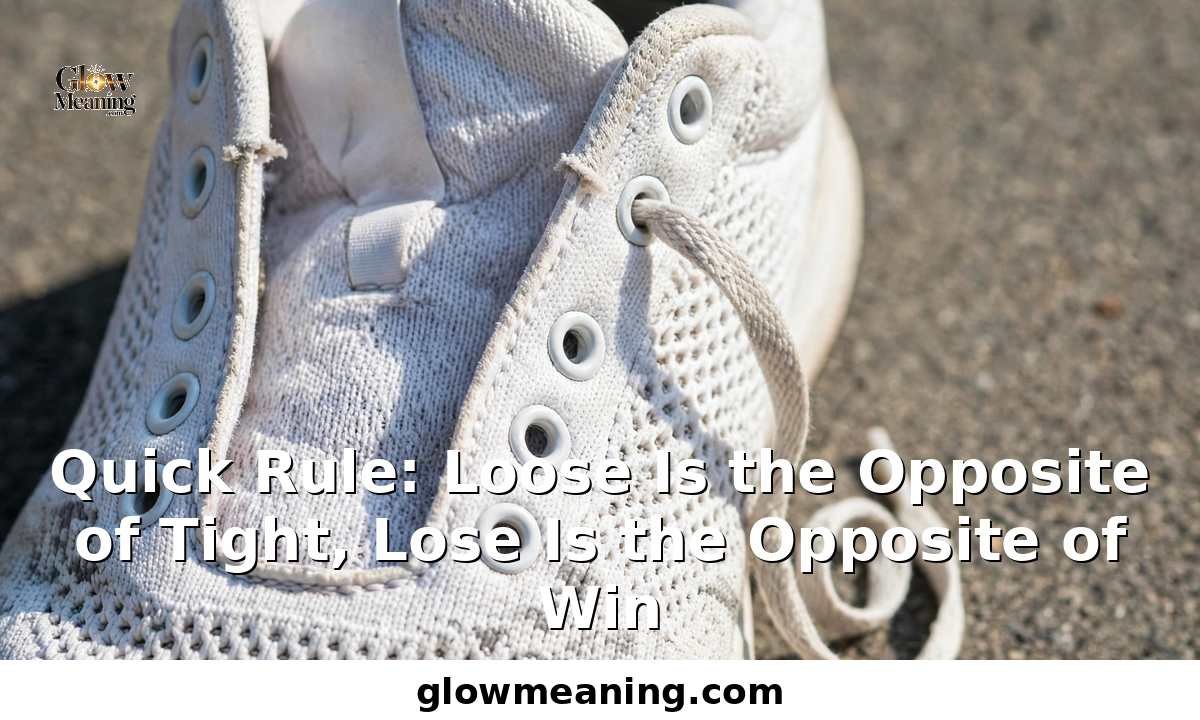
Loose describes something that is not tight or not firmly fixed. Lose is an action: to misplace something, to fail to win, or to stop having something. If you remember only this line, you will get most sentences right.
| Word | Job | Quick test |
|---|---|---|
| Loose | Adjective, describes something not tight | Can you replace it with “not tight”? Use loose. |
| Lose | Verb, an action | Can you replace it with “misplace” or “fail to win”? Use lose. |
Keep this table in mind as you read the examples below. Each word gets its own section, so you can see the pattern in real sentences.
What Does “Loose” Mean?
Loose is usually an adjective. It means not tight, not firmly attached, or free from restraint. A loose screw needs tightening, loose clothes feel roomy, and a loose dog has slipped its leash.
- My shoes feel loose after a long walk.
- She wore a loose sweater on the cold morning.
- The screw on the door handle is loose.
- He let his hair hang loose over his shoulders.
- There is a loose wire behind the television.
Notice the pattern in every example. The word describes a thing, not an action. If your sentence describes how something fits or how firmly it is held, “loose” is the right word.
Loose can also be a verb, meaning to release or set free, as in “the farmer loosed the horses into the field.” That use is rare in everyday writing, so in most sentences you write, loose will be an adjective.
What Does “Lose” Mean?
Lose is always a verb. It means to misplace something, to fail to win, or to stop having something you once had. You lose your keys, you lose a game, and you can lose your temper or lose weight.
- Do not lose your ticket on the way home.
- Our team does not want to lose this match.
- She hopes to lose ten pounds before summer.
- He did not want to lose his place in line.
- Try not to lose your patience with the new software.
Notice the pattern here. Every example is an action or an outcome, not a description. If your sentence is about something happening, like misplacing or failing, “lose” is the word you need.
The past tense of lose is lost, and the “ing” form is losing. Both keep the single “o” spelling, which is a helpful clue when you are unsure.
Loose vs Lose: Side-by-Side Comparison
This table puts both words together so you can compare them at a glance. Use it as a quick reference when you are editing your own writing.
| Word | Part of speech | Meaning | Pronunciation | Example |
|---|---|---|---|---|
| Loose | Adjective (rarely a verb) | Not tight, not firmly fixed | Looss, with an S sound | “These pants are too loose.” |
| Lose | Verb | To misplace, fail to win, or stop having | Looz, with a Z sound | “Do not lose your wallet.” |
Read the example row out loud. The two words sound close, but the ending sound is different, and the job each word does in the sentence is completely different.
The Double-O Trick: How to Remember

Here is the memory trick students remember best. Loose has a double O, and that extra room between the letters matches its meaning: not tight, with extra room. Lose lost an O, just like losing means something is gone.
Think of it this way. A loose shirt has extra room, and the word “loose” has an extra O. Something you lose is missing, and the word “lose” is missing an O. Two checks, same answer.
Try the trick on a real sentence. “My ring is loose on my finger.” The ring has extra room, so the double O fits. “I do not want to lose my ring.” Something is missing, so the single O fits. Once you see it, you will not unsee it.
How to Pronounce Loose vs Lose
Pronunciation gives you a second check, and it is the one native speakers use without thinking. Loose rhymes with goose and ends with a soft S sound. Lose rhymes with choose and ends with a Z sound.
Say them slowly, out loud. “Looss” and “looz” feel different in your mouth, even though they look almost the same on paper. If you hear a Z sound in your head, write “lose.” If you hear an S sound, write “loose.”
This trick helps most when you are speaking or proofreading aloud. Reading a sentence out loud catches errors that silent reading misses, especially with lookalike words like these.
Why Spellcheck Won’t Save You
Spellcheck checks spelling, not meaning, and both of these words are spelled correctly on their own. A sentence like “I do not want to loose my phone” will pass most spellcheckers, because “loose” is a real word. The error is in the choice, not the letters.
That is why proofreading matters more than software here. Read your sentence out loud and ask what job the word is doing. Is it describing something? Is it an action? The answer picks the word for you, every time.
Grammar tools can help, but do not rely on them alone. The quick rule in this guide works even on paper or on your phone.
10 Common Mistakes With Loose and Lose

Each row below shows a common error, the fix, and why the fix is right. Study the pattern, and you will start catching these in your own drafts.
| Wrong | Right | Why |
|---|---|---|
| I do not want to loose my phone. | I do not want to lose my phone. | Misplacing something is an action. |
| My pants are too lose. | My pants are too loose. | Describes fit, not an action. |
| He might loose the game. | He might lose the game. | Failing to win uses lose. |
| The knot is lose. | The knot is loose. | Describes something not tight. |
| I want to loose weight. | I want to lose weight. | Shedding weight is an action. |
| Her tooth is lose. | Her tooth is loose. | Describes something not firmly fixed. |
| Do not loose your temper. | Do not lose your temper. | Losing control is an action. |
| The dog got lose from its leash. | The dog got loose from its leash. | Describes being free, not an action. |
| We could loose the match. | We could lose the match. | Failing to win uses lose. |
| This lid is lose. | This lid is loose. | Describes a poor fit. |
Quick Quiz: Loose or Lose?
Try these three sentences before you peek at the answers. Say the rule out loud for each blank, and the answer usually follows.
- I do not want to ___ my keys, and my new belt feels too ___.
- The team could ___ the final if the star player gets a ___ ankle brace.
- She will ___ her grip if the rope stays ___.
Answers: 1. lose, loose. 2. lose, loose. 3. lose, loose.
How did you do? If you missed one, go back to the double O trick and try the pronunciation test on that sentence. Most misses come from rushing, not from a missing rule.
Frequently Asked Questions About Loose and Lose
What is the difference between loose and lose?
Loose is an adjective meaning not tight or not firmly fixed, while lose is a verb meaning to misplace something or fail to win.
How do you remember loose vs lose?
Remember the double O trick: loose has an extra O because it means extra room, while lose lost an O, just like losing means something is gone.
Is loose ever a verb?
Yes, but rarely. As a verb, loose means to release or set free, as in loosing an arrow, but in everyday writing it is almost always an adjective.
How do you pronounce loose and lose?
Loose rhymes with goose and ends with an S sound, while lose rhymes with choose and ends with a Z sound.
Why does spellcheck not catch loose and lose mistakes?
Spellcheck only checks spelling, and both are correctly spelled words, so it cannot tell which meaning you intended.
What is the past tense of lose?
The past tense of lose is lost, as in “I lost my keys,” and it keeps the single O spelling.
Is “loose weight” ever correct?
No, losing weight is always spelled “lose weight,” because shedding weight is an action, not a description of something not tight.
Conclusion
Loose and lose look almost the same, but they do two different jobs, and now you know each one. Something not tight takes “loose,” and an action like misplacing or failing takes “lose.” That one line is the whole rule, and it travels with you into every sentence you write.
Keep the double O trick in your pocket, say the word out loud when you hesitate, and these two words will stop slowing you down. Read your sentence once more before you send it, and the right word will usually stand out. Good writing is often just small words used in exactly the right place.

Professional content creator with 4+ years of experience in lifestyle, beauty, and meaningful digital storytelling through Glowmeaning.com.
